
PHE 685 Final Project Part One
Introduction
The practice experience plan will use Coregulation to reduce social anxiety. The project will include completing surveys, conducting interviews, collecting and compiling data, and analysis. This is important because Coregulation is a human communication technique with a group or an individual that helps people regulate anxiety, burnout, and health by restoring consistency to the polyvagal nervous system (Coregulation Health, n.d.). Coregulation can be used for self-management or purposefully by healthcare professionals, educators, therapists, supervisors, friends, and family to sustain health and performance (Coregulation Health, n.d.). The information gathered from the surveys and interviews will give insight into whether Coregulation is effective.
Individuals aged 60 and older residing in a nursing care facility will participate in this project. This will include the participation of five residents and two certified nurse aides. Dr. Robert Metcalf of the Coregulation Health Institute will assist and guide with the research and findings.
Social determinants of health (SDOH) affecting older adults are community and social context, neighborhood and built environment, and healthcare access and quality. Approximately 1 in 4 community-dwelling older adults in the United States is socially isolated, which can adversely affect their health and well-being (Office of Disease Prevention and Health Promotion [OASH], 2025). Older adults with decreased finances are more likely to have disabilities and die younger (Office of Disease Prevention and Health Promotion [OASH], 2025). Disability is likely to occur earlier in life for people with lower incomes. Social isolation and loneliness are linked with a higher risk of dementia and other serious health problems in older adults, but having positive social relationships can assist people in living longer, healthier lives (Office of Disease Prevention and Health Promotion [OASH], 2025). Neighborhoods and the built environment affect the probability of aging well. Accessible homes and dependable public transportation can permit older adults to live independently (Office of Disease Prevention and Health Promotion [OASH], 2025). Healthcare access and quality are a priority for people for life, and the risk for chronic health conditions like heart disease, dementia, arthritis, and type 2 diabetes rise as people get older. Most older adults have at least one chronic condition, with many having two or more requiring special care (Office of Disease Prevention and Health Promotion [OASH], 2025).
Coregulation Health Institute’s mission is to improve mental health and well-being by focusing on social disconnection via research, training, education, and support programs (Coregulation Health, n.d.). Coregulation Health Institute envisions a future in which every person has the resources and tools to build strong social connections and thrive (Coregulation Health, n.d.). The project will impact the residents, their families, friends, and staff at the nursing care facility.
Communication, planning, and technical resources can be potential barriers to completing the project and its corresponding artifacts. Understanding the project's goals, criteria, and messaging can lead to confusion and disconnection. Poor planning can delay outcomes and create unrealistic deadlines. Resources and technical barriers stem from a lack of the necessary skill sets or tools to complete the project. Weekly meetings will be scheduled to discuss issues and clarify what is needed for the project to succeed, while fostering transparency. Everyone involved in the project will keep a calendar with reminders and communicate via email, texts, Zoom meetings, and phone calls (Cabañero-Garcia et al., 2025).
Competency Plan
Five public health competencies will be addressed in this project, which are the following:
• CEPH 18 – Communication and Outreach Plan
• CEPH 20 – Educational Training Materials or Media Materials
• CEPH 9 – Document Outlining Research Questions, Methodology, and Scope
• CEPH 7 – Written Report Including Identified Data and Highlights Assets and Needs
• CEPH 19 – Communicate Audience Appropriate Public Health Content, in Writing and Oral Presentation to Non-academic Audience, Non-Peer Audience
CEPH 18 will address Coregulation for Social Anxiety. It will entail dealing with social anxiety, which causes loneliness and social disconnection, and is harmful to human health. Demographic groups affected severely in the US include seniors, students, medical patients, and military veterans. The focus will be on seniors in a nursing care facility. A plan has been developed for what information should be communicated, who should receive it, when it should be delivered, where it will be shared (e.g., email, social media, mail), and how those communications will be tracked and analyzed.
CEPH 20 will describe the importance of cultural humility in public health communication. Training will be developed for the site that focuses on communicating public health content and explains why cultural humility is an important consideration when creating public health communications.
CEPH 9 will document how data will be stored, organized, and archived to ensure transparency and integrity. Developing a co-regulation-based intervention while integrating components such as active listening, validation, and practicing coping skills.
CEPH 7 will present data collected and analyzed from local mental health providers, schools, and social service agencies to identify trends in service use related to social anxiety. Conduct one-on-one, semi-structured interviews with, but not limited to, mental health professionals, school counselors, community leaders, and local physicians. Blood pressure readings will be taken before and after participants' weekly meetings. This will show how Coregulation affects an individual physically.
CEPH 19 will create materials to help the community understand healthy and effective ways to manage social anxiety through Coregulation. Materials will be created to communicate information orally, in writing, and electronically.
The work that will be performed during this practice experience will enable Coregulation to have a positive impact on participants at the nursing care facility. Participants who use Coregulation will enhance their emotional stability and mental health. This will address social determinants of health (SDOH), such as social isolation, emotional well-being, and access to quality care. Emotional support will help the residents to manage anxiety, stress, and emotional distress. Participants will be able to cope with daily life challenges. Symptoms of depression and anxiety will be reduced using coregulation by using a calm tone of voice and active listening. Coregulation will include the caregivers (nurse aides). Coregulation will help caregivers gain trust and help the participants feel safer. This will ensure that participants feel seen and heard, improve their well-being, and become more willing to participate in their care.
The participants will have better social interactions and companionship. These involvements can counteract feelings of loneliness and isolation, which can contribute to poor health outcomes like cognitive decline and premature death.
Methodology
Once the project is completed, artifacts will be provided to show that all competencies have been met. Since part of this project is performed virtually, weekly meetings will be held with Dr. Metcalf via Zoom. In these weekly meetings, discussions will focus on data collection, participants’ meetings, and the steps to take going forward. The meetings will be a time to ask and answer questions about the project's progress. Coregulation training materials will be obtained from the Coregulation Health Institute website. Microsoft Word and Excel will be used to document survey findings, including graphs and charts. The surveys will include data measuring participants’ progress while using Coregulation. Blood pressure readings will be taken before and after the meetings to measure how Coregulation affects the body. Weekly in-person meetings with the participants will entail a detailed plan for this group, along with integrating cultural awareness and promotion. A written report will be prepared showing how Coregulation affected the participants in the nursing care facility. The report will have evidence from surveys, interviews, meetings, notes, and peer-reviewed references. The report will reveal how participants’ social interactions have improved, thereby enhancing their health and well-being.
• This is a 20-week project with the following timeline for activities, competencies, start and completion dates of the following:
• Weekly Zoom meetings with supervisor for CEPH 18 and 20, beginning on 11/28/2025 and ending on 4/10/2026
• Coregulation Survey for CEPH 7 and 9, started on 11/24/2025 and will be given on 1/5/2026, 3/2/2026, and 3/30/2026
• Weekly Blood Pressure Readings for CEPH 9 and 19, began on 12/22/2025 and will end on 4/13/2026
• Participants' Weekly Meetings for CEPH 19 started on 11/24/2025 and will be completed on 3/30/2026
• Written Report for CEPH 7, 9, 18, 19, and 20 started on 12/15/2025 and will be completed on 4/5/2026.
Results
Description
The participants who will remain anonymous are Ms. Red, Ms. Orange, Mr. Green, Mr. Blue, and Ms. Purple. During the practice experience, a few activities are being undertaken to meet the chosen competencies CEPH 7, 9, 18, 19, and 20.
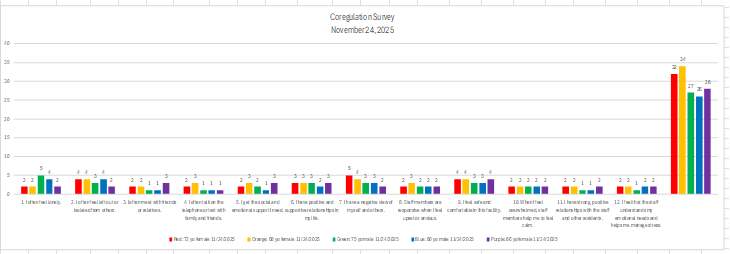
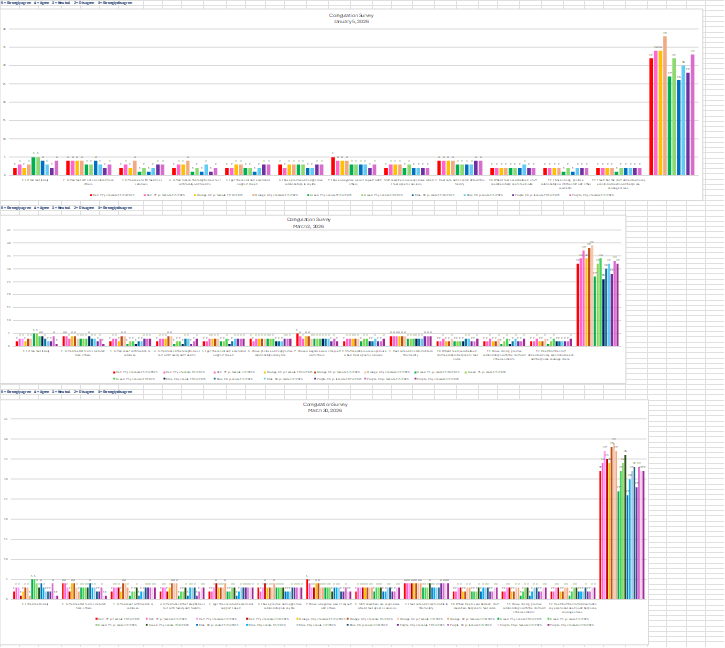
CEPH 7 is being met using a survey designed to measure participants’ social anxiety. The highest score is 60, the median score is 36, and the lowest is 12. The survey was given on 11/24/25 and 1/5/26. The survey was given again on 3/2/26 and 3/30/26. As of now, participants have shown improvement in social anxiety, as indicated by surveys taken on 11/24/25 and 1/5/26. They have continued to improve as indicated by surveys taken on 3/2/26 and 3/30/26. Weekly meetings with the five participants have reduced their social anxiety, as reflected in survey data. On average, participants' results increased by 5 points. Improvements were observed in feelings of loneliness, safety and comfort in the facility, and negative views of themselves.
CEPH 9 is being met by storing, organizing, and archiving information in an Excel spreadsheet to document survey responses, blood pressure readings, and meeting notes. Information from the participants has been documented to reflect how the use of Coregulation is affecting the participants. The participants have expressed that they enjoy meeting individually rather than in a group setting. Group meetings have started and have been conducted with two participants: Ms. Purple and Mr. Blue.
CEPH 18 is being met, with a focus on the primary population of adults over 60 residing in a nursing care facility. Information is shared via email, Zoom meetings, and in-person meetings.
CEPH 19 is being met with materials obtained from the Coregulation Health Institute’s website and information from Dr. Robert Metcalf, the site supervisor. A written report will be prepared, supported by evidence from surveys, interviews, notes, meetings, and peer-reviewed references.
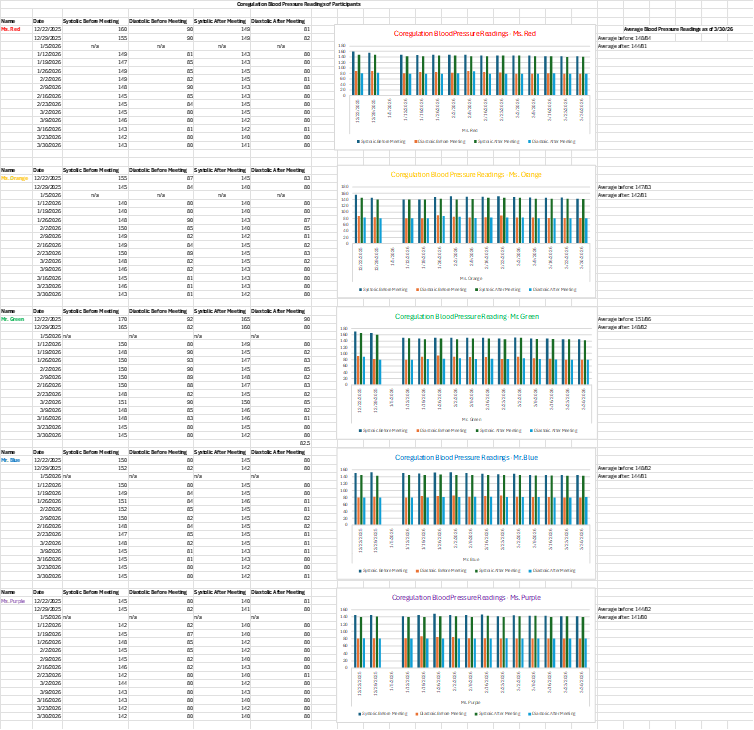
CEPH 20 is being met by introducing music during meetings with participants. Before-and-after blood pressure readings show that including music improves outcomes. Blood pressure readings are taken weekly by two CNAs before meetings and after meetings starting on 12/22/2025. The average blood pressure readings were as follows as of 2/23/2026:
BeforeAfter
◼️ Ms. Red 150/86 145/81
◼️ Ms. Orange 147/85 142/82
◼️ Mr. Green 153/87 150/83
◼️ Mr. Blue 150/83 144/81
◼️ Ms. Purple 145/83 140/81
The average blood pressure readings were as follows as of 3/3
BeforeAfter
◼️ Ms. Red 148/84 144/81
◼️ Ms. Orange 147/83 142/81
◼️ Mr. Green 151/86 148/82
◼️ Mr. Blue 148/82 144/81
◼️ Ms. Purple 144/82 141/80
Impact
The surveys, meeting notes, and graphs are vital to the field of public health. These artifacts will shape policy, resource allocation, and public behavior. Surveys capture data and graphs showcase trends, allowing representatives to observe disease trends, recognize health disparities, and communicate risks effectively.
Coregulation will assist the organization and impact the target population by improving their physical and mental health. The participants reside in a nursing care facility. The participants are likely to develop mental health conditions like anxiety and depression disorders (World Health Organization [WHO], 2025). These same individuals also experience decreased mobility, frailty, chronic pain, and numerous health issues (World Health Organization [WHO], 2025). Huerta & Metcalf (2025) reported that Medicare spent approximately $6.7 million in excess on nursing and hospital facilities to address the needs of older adults affected by social isolation. Being socially disconnected is like people smoking about 15 cigarettes daily, which impacts mortality and physical health (Huerta & Metcalf, 2025). Poor or insufficient social connections can increase the risk of developing diseases, such as the risk of stroke, which increases 32%, and the risk of heart disease increases 29% (Huerta & Metcalf, 2025).
The project of Coregulation for social anxiety in combating social disconnection among individuals over 60 years of age in a nursing care facility will keep moving forward. The weekly participants’ meetings will continue to gather information from the meetings and will also encourage group meetings. Meetings with staff members on this project will continue to gather more diagnostic and physical information about the participants and to understand how staff members view the use of Coregulation.
Conclusions
Summary
Coregulation was used to decrease social anxiety in individuals residing in a nursing care facility. The five participants were three women and two men, aged 68 to 86. The participants have multiple comorbidities, ranging from stroke to multiple sclerosis to acute chronic heart failure. A Coregulation survey was given to see the effects of Coregulation (See Appendix A). The participants answered 12 questions regarding their social anxiety. The survey was conducted on four different dates – 11/24/25, 1/5/26, 3/2/26, and 3/30/26 (See Appendix B). In the survey given on 1/5/26, the participants' scores increased by approximately 5 points. When the survey was given on 3/2/26 and 3/30/26, the participants’ scores decreased by approximately 1.8 points. Coregulation has also reduced the participants’ blood pressure levels (See Appendix C). Blood pressure was measured before and after instituting Coregulation. Systolic and diastolic levels have decreased by approximately 1 to 5 points. Improvements continued in feelings of loneliness, feelings of safety and comfort in the facility, and negative views of themselves.
Strengths and Limitations
The strength of my practice experience regarding the five competencies was successfully conducting the survey. CEPH 7, where the participants were willing to answer the questions in a timely and honest manner. The limitations were due to having only 10 weeks to complete the project and to a limit of 5 participants. The participants were very concerned about privacy. The participants were adamant about staying anonymous to continue with the project. CEPH 9, where a plan for Coregulation to be used after the project is completed, is being discussed with the administration at the nursing care facility. Again, due to time restraints, it is more theoretical. The long-term impact would not be evaluated. CEPH 18, where the survey was created, enabled efficient communication with participants. The participants responded well to the questions. The limitations among the participants were that none of them were computer-savvy, lacking knowledge of how to use a computer, laptop, tablet, or cellphone (See Appendix D). A survey was conducted in person during weekly meetings, with participants’ responses documented manually. CEPH 19 and 20 had charts created to capture survey data and blood pressure readings. The participants were willing to answer questions and have their blood pressure taken. Relaying the information to participants, staff, and administration went well. Incorporating humility was met by introducing music to the participants (See Appendix D). Listening to their choice of music made it easier for the participants to share their thoughts and become more sociable. Because this project was short, it was difficult to measure the impact of cultural humility.
Artifacts Demonstrating Competencies
See Appendix.
Further Analysis
Nursing care facilities must shift from a compliance-driven model to one concentrated on emotional safety, which involves addressing staff training, environmental design, and organizational culture to effectively implement Coregulation (Mahler, 2022). Continued focus on Coregulation helps manage resident behaviors, such as agitation, by creating an easygoing environment rather than relying solely on medication interventions (Mahler, 2022). Staff are quick to follow the rules rather than understand the individual’s experience. Training should move staff to asking, "What does this individual need from me?" rather than just managing behavior. Coregulation is essentially non-verbal. Staff need to be trained to regulate their own energy, use calm, rhythmic actions, and control facial expressions and posture to indicate safety.
Additional analysis of Coregulation within a nursing care facility can help identify staff burnout and improve staff retention. The physical environment can be evaluated by its impact on a resident’s behavior. Communication during staff handoffs can be improved. This could help staff recognize a resident’s condition and support better care planning. Training effectiveness can be measured by the impact of staff interactions, revealing useful skills and pinpointing where more training is needed.
References
Agency for Healthcare Research and Quality. (2022, March). Best practices for promoting emotional well-being in nursing home residents [PDF]. https://www.ahrq.gov/sites/default/files/wysiwyg/nursing-home/promoting-emotional-wellbeing.pdf
Cabañero-Garcia, E., Martinez-Lacoba, R., Pardo-Garcia, I., & Amo-Saus, E. (2025). Barriers to health, social and long-term care access among older adults: A systematic review of reviews. International Journal for Equity in Health, 24(1). https://doi.org/10.1186/s12939-025-02429-y
Centers for Disease Control and Prevention. (2024, May 15). Health effects of social isolation and loneliness. https://www.cdc.gov/social-connectedness/risk-factors/index.html
Coregulation Health. (n.d.). About us — coregulation health. https://coregulationhealth.org/about-us
Huerta, W., & Metcalf, R. (2025, October 21). The role of community businesses and organizations in the loneliness epidemic — coregulation health. Coregulation Health. https://coregulationhealth.org/journal/l16sih7dryka5ct06um42fnvsb6i8d
Mahler, K. The power of CO-regulation and interception. Kelly Mahler Blog [Blog series]. Retrieved April 27, 2022, from https://www.kelly-mahler.com/resources/blog/the-power-of-co-regulation/
Metcalf, R. (2021, June 2). Coregulation basics — coregulation health. Coregulation Health. https://coregulationhealth.org/journal/coregulation-basics#:~:text=Coregulation:,find%20one%20or%20more%20Partners
Nagel, L., Cavallini, A., Tesky, V., Schall, A., Katerinis, K., Meidinger, C., Arens, E., Ulrich Stangier, U. (2024, September 1). Emotion regulation in older nursing home residents with and without depression and younger comparison samples. Geriatric Nursing, 59. https://doi.org/10.1016/j.gerinurse.2024.07.014
Office of Disease Prevention and Health Promotion. (2025, November 19). Social determinants of health and older adults. https://odphp.health.gov/our-work/national-health-initiatives/healthy-aging/social-determinants-health-and-older-adults
World Health Organization. (2025, October 8). Mental health of older adults.
Appendix
A. First Competency: CEPH 9: Design a population-based policy, program, project or intervention.
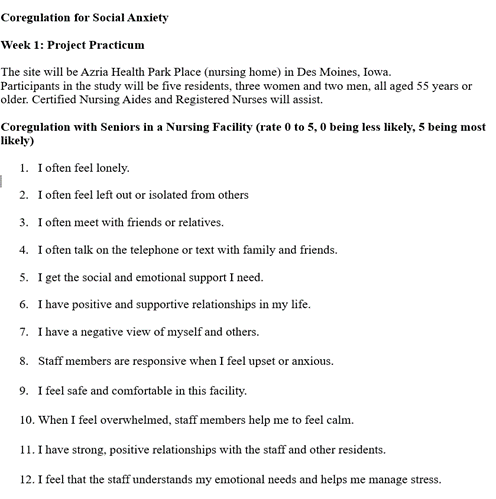
Coregulation Survey
B. Second Competency: CEPH 7: Assess population needs, assets and capacities that affect communities’ health.
Coregulation Survey Data

C. Third Competency: CEPH 19: Communicate audience- appropriate public health content, both in writing and through oral presentation to a non-academic, non-peer audience with attention to factors such as literacy and health literacy.
Participants’ Weekly Blood Pressure Readings
D. Fourth Competency: CEPH 18: Select communication strategies for different audiences and sectors.
Coregulation Participants Meetings
Coregulation Participants
The survey was conducted at Azria Health Park Place, a nursing care facility in Des Moines, Iowa on November 24, 2025. The survey participants are five residents: three women and two men. All residents are between 68 and 86 years old. The residents were all born and raised in Iowa. The two certified nursing aides will also participate and assist.
The survey will be using the Likert Scale. The rating scale has been changed from ‘likely’ to ‘agree’. The rating scale will be as follows:
5 = Strongly agree
4 = Agree
3 = Neutral
2 = Disagree
1 = Strongly agree
The survey will not use the participants’ real names. Assigned colors will identify the participants.
November 24, 2025
Ms. Red: This is a Caucasian 72-year-old female who suffered a stroke. She is married with four children. Red is in the nursing care facility for rehabilitation. Red is very concerned about her appearance. There is a noticeable physical difference between the photos of Red from 2024 and the way she looks now. Red refuses to see friends; only immediate relatives are allowed. She speaks with friends and family on the phone, as well as via texts and emails. Red does like being in the nursing care facility.
Ms. Orange: This is a Caucasian 68-year-old female with multiple sclerosis. Orange has two children and is divorced. Orange does not socialize much due to her disease. Orange only likes to be around her family. Orange dislikes being in the nursing care facility and is anxious to go back home.
Mr. Green: This is an African American 75-year-old male who had a stroke. Green is divorced with no children. Green is willing to participate in the project and does not like being in the nursing care facility. Green has some friends and family who visit but does not always enjoy their visits.
Mr. Blue: This is a Caucasian 80-year-old male who has chronic obstructive pulmonary disease (COPD) and has had a heart attack. Blue is an Army veteran but did not retire. Blue has been married twice. First marriage ended in divorce, and he became a widower with the second marriage. Blue has five children and seven grandchildren. Blue did not speak much, and his responses were limited to a few words. Blue does like being in the nursing care facility.
Ms. Purple: This is an 86-year-old African American female with acute chronic heart failure. Purple is a widow and was married for 64 years. Purple has six children, 14 grandchildren, and three great-grandchildren. Purple does not talk or text family and friends. Purple is not tech-savvy as she has no cell phone or other electronic devices. Purple asked, “What is Facebook?” Purple did not speak much concerning the facility, as she does not like being there. When it comes to staff and the facility, not all the residents are satisfied. All shared that they do not like being in the facility. Their survey responses indicate they do not have positive relationships with staff, feel staff members are not responsive, and do not understand their emotional needs. But the residents feel safe at the facility for the most part.
CNA1: She has been a certified nurses’ aide (CNA) for 6 years and has been with Azria Health Park Place for 3 years. CNA1 is currently obtaining her BS degree in Nursing with the goal of becoming a registered nurse (RN)
CNA2: She has been a CNA for 2 years and has been with Azria Health Park Place for 7 months. She says that although her job can be difficult, she enjoys being a CNA and wishes to become a social worker.
December 1, 2025
This meeting was short. The participants were in a solemn mood. This was due to the Thanksgiving holiday; it snowed on Friday in Iowa. Some of the participants were able to go away and visit with family because they lived in the Des Moines, Iowa area. Two participants did not go away to visit family (Mr. Blue and Ms. Red). Ms. Red’s family visited her in the facility, while Mr. Blue had no family or friends visit. It was discovered that Mr. Blue had no visitors after dropping off my mother when visiting with me. My husband went back, brought him Thanksgiving dinner, and spent some time with him. This cheered up Mr. Blue a little. All participants were depressed that they could not spend more time with their family and friends during the Thanksgiving holiday. None of them was very talkative at this meeting. I discussed with the two nurses’ aides that, as far as their vitals, their blood pressure and glucose readings were higher. It is believed it was due to stress and depression.
December 8, 2025
The participants were in pretty good spirits. They were still a little depressed from the Thanksgiving holiday and were not really looking forward to Christmas or New Year’s. I had to really get them to talk about what they were feeling at this meeting. All were concerned about the weather and whether it would make a difference between being with family and staying at the facility. Ms. Purple and Ms. Red were particularly sad because they will not be able to go Christmas shopping and participate in their families Christmas traditions. Mr. Blue and Mr. Green do not appear to care much about Christmas and have stated that they are both looking forward to the new year but without all the fanfare. Ms. Orange was not feeling very well, so I did not spend much time with her. Ms. Orange was appreciative of me visiting with her this week.
I spoke with the two nurses’ aides. From now on they will be CNA1 and CNA2. CNA1 and CNA2 reported that the participants blood pressures and blood glucose levels have decreased. They make it a point to check in with them throughout their shifts. CNA1 and CNA2 both work a 10-hour shift from 7 am to 5:30 pm, Monday through Friday, with alternating weekends and holidays. CNA2 will be working Christmas Eve and Day. CNA1 will be working on New Year’s Eve and Day.
December 15, 2025
I met with the five participants individually and they were all in better spirits. All are over the cold, snow, and ice. Ms. Orange is feeling much better but she is trying to get into the Christmas spirit. I gave them an assignment to choose one of their favorite songs, but the song must be one that makes them smile and brings good feelings and good memories. I spoke with all of them to let them know that we will all get together and meet each other at our meeting on 12/22. Of course, there was some apprehension and resistance to the idea, especially from Mr. Blue, Ms. Red, and Ms. Orange. I let them know that CNA1 and CNA2 will be present also. I discussed with the CNAs that on the day of the meeting, they get their blood pressure before the meeting and then take their blood pressure while we are engaging in the meeting and then take their blood pressure after the meeting was over. Ms. Purple stated that she has noticed seeing the CNAs more since beginning this project.
December 22, 2025
This week’s meeting was interesting. This was the week where we were all going to meet each other in person and have an impromptu Christmas gathering. No one attended. I waited 20 minutes to see if anyone would show up and no one did. All decided that they were not ready to meet each other yet and did not want to share anything personal in a group setting. I respected their decisions and proceeded with meeting with them individually. All of them were doing well and I did ask them about choosing their favorite song. All completed this task. Good news is that we are going to have a gathering after the new year. So, at our next meeting on 1/5/26, we will all get to meet each other. The participants felt it would give them more time to prepare. The CNAs took their blood pressure readings before and after the meeting. The readings show that their diastolic and systolic readings did decrease after the meeting. The participants were in good spirits, but still a little bit apprehensive about the Christmas holiday (but mostly about the weather).
December 29, 2025
The meeting was very short today. All the participants celebrated Christmas with their friends and family. Ms. Orange, Ms. Purple, and Mr. Blue just got back today. The participants were tired today and were not wanting to spend a lot of time talking. The weather in Iowa was great, almost springlike. The CNAs took the participants blood pressure before and after the meeting and it showed a decrease. After we meet next week, I am going to administer the survey I conducted at the beginning to see if there is any improvement.
January 5, 2026
I did not meet with the participants due to illness. I will meet with them on January 12 and conduct the Coregulation Survey. I called and spoke with CNA1 and was told they were all doing well. The participants were disappointed that we did not meet this week but CNA1 and CNA2 met with them individually while doing their rounds. No blood pressure checks were performed to correlate with the relationship between blood pressure values before and after our meeting.
January 12, 2026
Individual Meeting
The meeting today was wonderful. Since we did not meet last week, I had a brief individual meeting with each participant and then introduced meeting together as a group. Two participants came by for the group meeting – Ms. Purple and Mr. Blue – more about them later.
Individually, I administered the survey again and there was a slight increase from the last survey on 11/24/25. The totals increased anywhere from two to five points. In speaking to the participants individually, they expressed the following reasons for their increase in this survey on 1/12/26:
Ms. Red: Red’s survey increased by two points. Red is still feeling self-conscious about her appearance but believes she is feeling a little better about herself. Socializing with friends and family via telephone, text, and visiting has improved but she still will not do video chats and was not willing to meet as a group today. Red admits that she still has some work to do. Red is a big Elton John fan and she chose Bennie and the Jets because she remembers her and her friends singing it very loudly while riding in the back of a pickup truck and it was pouring rain, they got soaking wet and all of them got sick.
Ms. Orange: Orange points increased by four. Orange still does not like being in the nursing care facility and she too is not ready to meet as a group. Orange believes she may never be ready to participate in a group setting but she does like the individual meetings. Orange also likes seeing the CNAs more and feels that emotional support is improving. Orange also still feels lonely and isolated but she believes it is more on her than on others. Orange likes country music and she chose The Judds’ Rockin' with the Rhythm because she remembers watching her mother and father dance to this song.
Mr. Green: Green’s points increased by five points. Green continues to feel isolated and lonely. Green has improved with meeting with family and friends and admits to enjoying their visits just a little bit more but not much. Green would rather leave when they leave and misses living on his own and taking care of himself. He is having difficulty with physical therapy and believes he is not recuperating quickly enough. Green does not want to participate in group meetings but he would like to continue with the individual meetings. We discussed music and the song he chose was We Are the Champions by Queen. At that time, he was a member of a softball team who won their championship and the song was played at their celebratory dinner.
Mr. Blue: Blue’s survey points increased by four. He participated in the group meeting with Ms. Purple. Blue stated that he feels less lonely and isolated from others. He has reached out to his children by calling them on the phone. He wants to try and call them at least once a week whereas before he did not call them at all. He also likes connecting with my husband who is a fellow veteran.
Ms. Purple: Purple survey points increased by five points. Feeling lonely and isolated has decreased. She wants to have stronger, positive relationships with the residents, which is one of the reasons she decided to participate in the group meeting. She is contemplating getting a smartphone so that she can video chat with her family, especially her grandchildren.
Group Meeting – January 12, 2026
This was the first group meeting which was attended by Mr. Blue and Ms. Purple. We all introduced ourselves and I explained why we were meeting. The topic of conversation was primarily about music. Both were surprised of what I knew about music, especially from their eras. Mr. Blue stated he was a huge fan of 1950s Doo Wop music and one of his favorite songs was Yakety Yak by The Coasters. He remembers he would sing this song all the time and it drove his parents crazy which made him smile mischievously. Ms. Purple was more into Rhythm & Blues/Soul Music and her favorite artist James Brown. She chose Get on Up as her favorite song. Ms. Purple discussed that she chose that song because her and her husband sang that song in a talent contest at their social club and won. She said her husband was a great dancer and singer and could mimic James Brown except he couldn’t do the splits. We discussed how we can get others to participate in group meetings.
January 19, 2026
Met with Ms. Red, Orange, and Mr. Green individually. Had a group meeting with Ms. Purple and Mr. Blue which will be discussed later. It was an okay meeting with Red, Orange and Green. All complained about how cold it was and did not have any visits this week. I listened to music with them individually which seemed to put them in a better mood. I spoke with CNAs 1 and 2 to let them know I will not be coming by on 1/26. I also let the participants know of this as well. I let the CNAs and the participants know that the CNAs will be coming to speak with them individually and will share the information given to them. Red, Orange, and Green were okay with it and like the fact that the CNAs take more of an interest in their wellbeing.
Group Meeting – January 19, 2026
Mr. Blue and Ms. Purple and I met as a group today. Both Blue and Purple enjoy meeting as a group and both are not happy about how cold it is but this is Iowa. Ms. Purple felt the meetings are helping her be more sociable and she finds that she is smiling a lot more and looks for to the meetings. Mr. Blue is coming along slowly. He enjoys interactions as well. For this meeting, my husband came along and he really perked up. I played music and it was a good group meeting. Both are sharing a little bit more and wanted to brainstorm on how to get the other participants involved as one group.
January 26, 2026
Due to the extremely cold weather, no meeting was held. CNA 1 and 2 did meet with the participants individually. No group meeting. The participants did well.
Group Meeting – February 2, 2026
Decided this week to do the group meeting first with Ms. Purple and Mr. Blue. Both participants were in good spirits. Ms. Purple is adamant about having the remaining participants being involved in a group meeting. The CNAs are telling me that she asked if she could go and speak with them about participating in a group meeting. Ms. Purple is flourishing and even mentioned that being in the nursing care facility has become more bearable since participating in this project.
Mr. Blue is coming along as well. He mentioned that he feels less alone and commented that he likes feeling better without having to take another pill. I believe this is also due to the connection that he has with my husband. Mr. Blue even took the time to participate in playing Bingo on Saturday, which he has not done since he was at the nursing care facility. He would like the other participants to join the group meeting but he understands that you cannot make anyone do what they do not want to do. During the group meeting, no music was played because we mostly talked
Individual Meeting – February 2, 2026
I met individually Ms. Orange, Ms. Red, and Mr. Green. Mr. Green still does not want to meet as a group. He feels that he gets more out of the individual meetings. Mr. Green was not in the mood to listen to music but he did want to talk. He had refused visits from some friends over the weekend. CNA 1 spoke with him and he stated he was just not interested in visiting. Mr. Green said he stayed in his room, watching TV and reading. Mr. Green did mention that he would like to go to the library and he was told that they would speak with the Director to arrange an outing to the library.
Ms. Red is starting to think about joining the group meeting. She is feeling a little more at ease. She asked me to play Elton John’s “I’m Still Standing”. Surprisingly, she expressed that she is going to adopt this song to her battle with her stroke and wondered if they can play this song during her physical therapy. Ms. Red also participated in Bingo for the first time on Saturday and she found it to be all right but don’t get used to it. CNA 1 said Ms. Red is coming along and she too was surprised at her going to Bingo.
Ms. Orange is still skeptical about joining the group meetings. One of her children came to visit last Friday, brought her some clothes and food. Ms. Orange expressed that she was feeling a little low and wanted to listen to something upbeat. I played for her John Michael Montgomery’s “The Auctioneer Song”. That seemed to raise her spirits and she was surprised that I even knew that song. She had me play it three times. CNA 1 says Ms. Orange has been doing pretty good. She had a small multiple sclerosis episode last Thursday so that is probably why she is a little down. But she has expressed this and has let everyone know how she is feeling. CNA1 spent a little more time with her over the weekend and Ms. Orange was appreciative of the attention.
Individual Meeting – February 9, 2026
Met with Ms. Orange, Ms. Red, and Mr. Green. Nothing out of the ordinary. All were in good spirits and still awaiting an answer concerning an outing to the library for Mr. Green.
Group Meeting – February 9, 2026
Ms. Purple and Mr. Blue met and again nothing out of the ordinary. Group meeting went well.
Individual Meeting – February 16, 2026
Ms. Orange, Mr. Green, and Ms. Red were doing well. Meeting was short because it was movie night and all decided to participate. They were showing the movie, “In the Heat of the Night”, with Sidney Poitier and Rod Steiger
Group Meeting – February 16, 2026
No group meeting because Mr. Blue and Ms. Purple participated in movie night
Individual Meeting – February 23, 2026
Ms. Red, Ms. Orange, and Mr. Green were present for their individual meetings. I spoke with Mr. Green, surprised that he participated in movie night. Mr. Green let me know that he was a big fan of Sidney Poitier and always enjoyed the movie. He let me further know that he did not feel uncomfortable because he was engrossed in the movie. Once the movie was over, he went back to his room. Mr. Green told me that people wanted to discuss the movie with him but he did not want to stay and socialize
Ms. Red and Ms. Orange both enjoyed the movie and they stayed behind to discuss the movie. They also found themselves speaking with others about the movie and felt pretty good about it. Ms. Orange also let them know that she was participating in this project and it is helping her a little bit. Ms. Red agreed with what Ms. Orange said. It seems that Ms. Red and Ms. Orange are building a relationship. According to CNA 1 and 2, Ms. Red and Ms. Orange were seen together eating lunch and dinner since movie night.
Group Meeting – February 23, 2026
Ms. Purple and Mr. Blue attended. Both enjoyed the movie last week. Mr. Blue and Ms. Purple would like to work with the CNAs to start a weekly group for all in the nursing care facility to attend. Very surprised by Mr. Blue. He wants to enlist people who have been in the military and feels he can relate to them better in getting them involved. Ms. Purple would like to work on the ones who she never sees in the dining room or participate in events. She feels they would relate to her more than I can. I told them that I’m still waiting to hear back from the director about getting something like this started. I have also asked the CNAs to help facilitate this as well.
On March 2, I will perform the survey again to gauge where the participants stand concerning social disconnection and anxiety.
Individual Meeting – March 2, 2026
Participants were given the survey. On average, scores increase approximately two points. Participants are feeling slightly better than when given the survey on 1/5/2026. Mr. Green’s points increased by 2. Mr. Green still feels lonely and left out. Mr. Green still does not meet with his family or call them. But his negative view of himself has increased slightly. Mr. Green was noticeably upset because his request was denied for visiting the library. The facility was concerned about his ability to walk and overall physical safety, especially since the streets were icy. Mr. Green stated he was told that when it gets a little warmer and his walking improves, the facility will consider his request to go to the library. Mr. Green feels this is unfair and he has been in his room. Mr. Green’s blood pressure levels were higher this week. This is probably due to the frustration he is having for not being able to go to the library.
Ms. Red and Ms. Orange were of better spirits. We met in the common area of the facility. Both are enjoying each other’s company. Ms. Red’s survey points went up by 3 and Ms. Orange’s survey points increased by 9. Ms. Red and Ms. Orange have both improved in feeling overwhelmed, having strong positive relationships, and the staff understanding their needs and helping with managing their stress. Both are spending time with each other and seem to be creating a bond. They are interested in being their own group.
Group Meeting – March 2, 2026
Mr. Blue and Ms. Purple were doing wonderfully. Ms. Purple’s points decreased by 1 from the previous survey. Ms. Purple has improved with feeling lonely and feeling left out. CNAs have said she is speaking with other residents about starting a group of her own using Coregulation. Ms. Purple feels that the CNAs really care and are helping her more. She is also getting better with using her smartphone and she is proud of that.
Mr. Blue had an increase of 2 points in this current survey. He has shown improvement in feeling lonely and feeling that he is receiving emotional support. Mr. Blue is considering getting other involved in Coregulation too. He likes participating in bingo and he enjoys movie night as well. Mr. Blue and Ms. Purple would like to continue having these meetings once the project is over.
Individual Meeting – March 9, 2026
Ms. Red and Ms. Orange have become their own group. CNA2 informed me that these two have become a team. CNA2 stated that Ms. Red and Ms. Orange are having their meals together, coming to bingo and movie night together. Ms. Red is improving with her physical therapy. Ms. Red said to me that “the nursing home has become more bearable” due to being friends with Ms. Orange. They are now calling themselves, “Vintage Partners”. Ms. Orange agrees with Ms. Red. She is surprised that she is being more sociable and feels very comfortable with Ms. Orange. Ms. Orange still does not want to be at the nursing care facility.
Mr. Green was having a better week than last week. He is still disappointed about not going to the library. Mr. Green did go to movie night and when I saw him, he wanted to listen to music. He requested that I play the blues, so I played some B.B. King and John Lee Hooker. I asked him why did he want to hear the blues and he said, “just because”. He said family will be coming to see him this Saturday.
Group Meeting – March 9, 2026
Ms. Purple and Mr. Blue are doing well. Ms. Purple was getting over the flu, so kept the meeting short. Ms. Purple is getting the word around about Coregulation and she even mentioned it to her family and friends. Ms. Purple and Mr. Blue wanted to listen to some disco music, so I played that for them. Mr. Blue has been discussing the project with his children. He wanted to know when my husband was coming back to visit. I told him I do not know but I will let my husband know he was asking about him. CNA1 and CNA2 are both impressed by the two of them. They stated that they both seem more outgoing but not surprisingly, they do not want to be in the nursing care facility.
Individual Meeting – March 16, 2026
Mr. Green was doing okay. He was not very sociable and did not want to hear any music. He stayed in his room and was feeling down today. CNA1 informed me that he did not participate in his physical therapy and stayed in his room reading and watching TV. Mr. Green said to me that he wants a break from the nursing care facility and really wants to go to the library.
Ms. Orange and Ms. Red had a pretty good week. Once again, they both participated in playing bingo and movie night. I asked them if they would like to join Ms. Purple and Mr. Blue in a group meeting and both declined. Both feel more comfortable with one another and do not wish to join the others just yet. I explained to them that I only have two more weeks before this project is over. Ms. Orange and Ms. Red said they will think about it.
Group Meeting – March 16, 2026
Ms. Purple was doing much better than last week after recovering from the flu. She is looking forward to St. Patrick’s Day. She showed me her “Kiss Me I’m Irish” pin. She told me her daughter would bring her some corned beef and cabbage. She is feeling a little defeated because she has been trying to get others to use Coregulation and they are refusing. She referred to them as “stubborn old goats”. Ms. Purple did not feel like listening to any music and we talked the entire meeting.
Mr. Blue is doing well. He was excited when my husband visited during this meeting. He mostly talked with my husband. He and my husband talked about the Iran war, and before long, we were all discussing this.
Individual Meeting – March 23, 2026
I met with Ms. Red, Ms. Orange, and Mr. Green. Mr. Green was in a great mood today. He got to visit the library today. According to CNA1, the nursing care facility agreed with the physical therapist that part of his therapy could be spent walking to the library. As it turns out, the library is about 10 minutes away from the facility by car. The physical therapist will park the car as far away from the building in the parking lot. This will count as therapy for him. Mr. Green said he got to spend an hour at the library, got a library card, and borrowed some books. He is looking forward to returning the books to the library in a month. He was so moved that he had tears in his eyes. The CNAs and other participants have noticed his positive, joyful demeanor.
The Dynamic Duo, Ms. Orange and Ms. Red, are doing well. They really enjoy each other’s company and speak well of each other. Continuing with playing bingo and watching movies together.
Group Meeting – March 23, 2026
Ms. Purple and Mr. Blue are doing well. Ms. Purple and Mr. Blue are spreading the word about Coregulation. Ms. Purple went to church this past Sunday. It has been six months since she has been to church, and she said she enjoyed it. She was happy to see church members she had not seen in a while. Ms. Purple let them know she was part of a school project and thought she could introduce Coregulation to the congregation. Mr. Blue was good. My husband gave him a haircut and he liked it. What was different about Mr. Blue this meeting was that he made a new friend. Mr. Blue’s new friend is a veteran and seems to be compatible with Mr. Blue. Mr. Blue and his new friend came to this meeting and Mr. Blue focused more on his new friend than my husband.
Individual Meeting – March 30, 2026
Mr. Green, Ms. Orange and Ms. Red were in good spirits. To my surprise, they all wanted to meet together but did not want to include Ms. Purple and Mr. Blue. For some odd reason, they believe that Ms. Purple and Mr. Blue are more advanced in using Coregulation than they are. I told them that was not the case, but they insisted it would be just them. In any case, this is a breakthrough that they have clicked together for this final meeting. Mr. Blue is still excited about visiting the library. He was told that if any of the residents ask him about his whereabouts, he needs to tell them he is going to “special” physical therapy.
Group Meeting – March 30, 2026
This is the final meeting with Ms. Purple and Mr. Blue. Ms. Purple and Mr. Blue were disappointed that this was coming to an end. Both participants want the meetings to continue. They both enjoyed meeting every week and talking with me about themselves. Ms. Purple asked if I could continue this project with her church. Mr. Blue and his new friend wanted to know if they could share this with other veterans. Mr. Blue and his new friend are being discharged from the nursing care facility next week and Mr. Blue is moving in with his daughter and son-in-law. Mr. Blue plans to volunteer at the VA Hospital and would like to use Coregulation there.
E. Fifth Competency: CEPH 20: Describe the importance of cultural humility in communicating public health content.
See CEPH 19 artifact.