Abstract
This qualitative project explored how college students experience social anxiety and emotional comfort within campus environments. Using a thematic analysis of survey responses and observational notes, the study examined how students navigate social spaces, regulate their emotions, and seek grounding during moments of stress. Among the seventeen students, descriptions spanned a wide emotional range, from feeling grounded in social spaces to navigating persistent discomfort. Findings revealed two primary sources of emotional ease: the stabilizing presence of familiar social circles and the availability of quiet, low-stimulus campus spaces that allowed students to pause, reset, and regain clarity. Viewed as a whole, the themes illustrate how students carve out moments of safety and belonging through brief connections or pauses throughout their day. While the sample is limited, these insights deepen our understanding of how campus spaces can nurture emotional well-being.
Introduction
Social anxiety among college students is an increasingly concerning issue as it affects long-term quality of life, academic performance, and community engagement. In recent years, many colleges have noted an increase in students reporting anxiety, which highlights the importance of examining how day-to-day campus settings shape their experiences. At the University of California, Riverside (UCR), students often navigate moderately crowded walkways, dining areas, outdoor activity spaces alongside a mix of small classrooms and larger lecture halls.
Depending on the time of day and a student’s comfort level, these spaces can feel either manageable or overwhelming, influencing how at ease one may feel while navigating campus. Though there is still limited insight into how students interpret these spaces in their daily routines or which environments feel most supportive versus challenging. This project explores student experiences with social anxiety on campus using a brief in-person survey and an observational walking assessment. This project aimed to gain a clearer understanding of student experiences by gathering data through a brief five-question open-ended survey, accompanying demographic items, and a structured observation of social patterns across campus. Survey responses were examined using a thematic analysis approach, which involved reading through feedback to identify recurring ideas and shared experiences among students. The findings highlight themes related to social discomfort, coping strategies, and environmental factors that influence how students feel on campus. This report outlines these themes, discusses their significance, and offers recommendations to support students’ emotional health.
Methods
Setting, Participants, and Data Sources
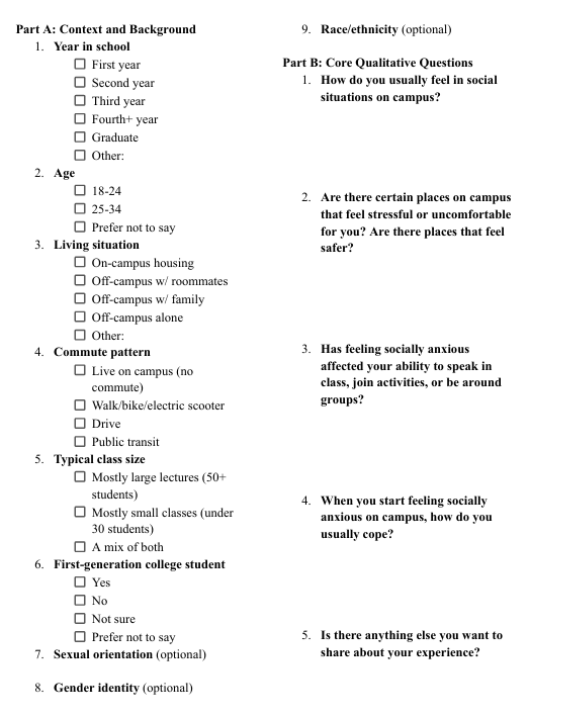
This project was conducted at UCR in partnership with the Coregulation Health Institute (CHI), a San Diego-based, non-profit organization focused on addressing social disconnection and supporting youth, students, families, educators, and communities through trauma-informed, science-based coregulation and coregulatory practices. A total of seventeen students participated in the in-person qualitative survey. All seventeen participants completed the same five open-ended qualitative questions, which explored how they typically feel in social situations on campus, which environments feel stressful or safe, how social anxiety affects their ability to participate in academic or social settings, and the coping strategies they use when anxiety arises.
To provide additional context, students also answered brief demographic questions related to year in school, living situation, first generation status, class size preferences, and commuting style. Questions about gender, ethnicity, and sexuality were optional to ensure students could participate without disclosing information they did not feel comfortable sharing. Data sources for this project included the qualitative survey responses, demographic information, and a structured observational checklist documenting social patterns and environmental conditions across campus.
Procedures
Data collection took place in person at various locations across the UCR campus where students naturally gather, such as walkways, outdoor seating areas, and study spaces. Students were approached informally and invited to participate in a brief qualitative survey about their experiences with social anxiety and comfort in campus environments. After providing verbal agreement, each participant completed the five open-ended questions and the demographic items on paper at the time of contact. No identifying information was collected, and all demographic questions, particularly those related to gender, ethnicity, and sexuality, were optional to ensure students could participate at their own level of comfort.
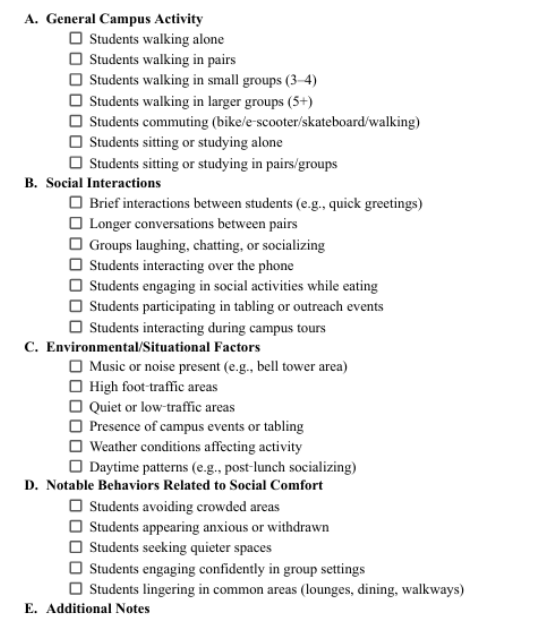
In addition to the survey, a structured observational walk was conducted using a detailed checklist to document social patterns and environmental conditions across campus. The checklist included sections on general campus activity (e.g., students walking alone, in pairs, or in groups; students studying or sitting in different configurations), social interactions (brief greetings, longer conversations, group socializing, phone interactions), environmental factors (noise levels, foot-traffic density, weather, presence of events), and behaviors related to social comfort (students avoiding crowded areas, seeking quieter spaces, or lingering in common areas). These categories supported consistent, systematic insights across multiple campus locations. For example, during one observation near the library entrance, several students were seen rerouting around a high-traffic walkway and choosing shaded seating areas instead, which aligned with survey responses describing a preference for quieter, low-stimulus spaces. Observational notes were used to contextualize survey responses and better understand how students navigated and interacted with different campus environments.
Analysis
All qualitative responses were reviewed and coded manually using a thematic analysis approach. The process began with an initial read through of all surveys to identify recurring ideas related to social comfort, stress, and coping. From these notes, preliminary codes were developed and refined into broader categories that captured shared patterns across participants. These categories were then shaped into the final themes that appear in the Findings section. Observational notes were used to contextualize the survey data by highlighting how students interacted with different campus environments. These findings do not suggest that only the seventeen participants experience stress or anxiety. Rather, they reflect the perspectives of those who participated and are not intended to represent the entire UCR student population.
Findings
Theme 1: Social Anxiety Exists on a Spectrum Among Students
Student experiences reflected a continuum of social anxiety, ranging from students who reported no anxiety, to those who experienced mild or situational discomfort, to others who described more persistent challenges that influenced their daily campus life. For some students, crowded or unpredictable settings triggered anxiety that limited their comfort with speaking in class, joining activities, or engaging socially, while others described their anxiety as mild or situational. A substantial group also shared that they generally felt comfortable on campus or that their anxiety had become more manageable over time. These varied responses illustrate that social anxiety is not a uniform experience. Instead, students move along a continuum shaped by personal history, social context, and familiarity with campus environments.
Theme 2: Comfort Increases in Familiar Social Circles
Many students expressed feeling most at ease when surrounded by people they trust, such as friends, relatives, roommates, or close social circles. These relationships offered a sense of grounding during both stressful moments and everyday interactions. Students emphasized that being with familiar individuals provided emotional clarity, reduced social pressure, and created a calming sense of belonging. As one participant explained, “Having my close friends around gives me a sense of stability. I don’t feel the need to perform because it’s a non-judgmental space, and they help me stay grounded when campus feels overbearing.” For many, community served as a stabilizing force, helping them navigate challenging situations, feel more confident in social settings, and maintain a stronger sense of connection throughout the day.
Theme 3: Quiet, Low-Stimulus Campus Spaces Support Emotional Ease
Students frequently highlighted the value of quiet, low-stimulus areas on campus to help manage stress and maintain emotional balance. Areas such as the library, shaded outdoor seating, quieter study nooks, and other low-traffic spaces gave students room to pause and distance themselves from the noise, movement, and social demands of busier parts of campus, regardless of their level of social anxiety. Many described these environments as places where they could reset, focus, and regulate their emotions before returning to busier parts of campus or continuing with their daily routine. These calming spaces were helpful for students across the spectrum of social anxiety, those who experienced significant discomfort as well as those who generally felt at ease, showing that predictable, low-stimulus environments play an important role in supporting students’ overall sense of comfort.
Theme 4: Students Use Simple, Accessible Coping Strategies
Across participants, many students described relying on simple, accessible coping strategies to regulate their emotions and manage moments of stress or social discomfort. These strategies varied widely but often included reading, listening to music, studying in quiet areas such as the library, spending time in greenspaces, playing sports, joining clubs, listening to podcasts, meditating, or participating yoga. Students emphasized that these activities helped them feel grounded, calm, and more capable of navigating campus life. Notably, these self-regulatory behaviors were described by students across the spectrum of social anxiety like those who experienced significant anxiety as well as those who reported minimal or manageable levels.
Discussion
The findings from this project highlight how students experience social anxiety in varied and nuanced ways, shaped by personal history, social context, and the environments they move through on campus. Rather than presenting as a single pattern, social anxiety appeared along a spectrum, with some students describing significant discomfort in crowded or unpredictable settings while others reported only mild or situational stress. Many also shared that familiarity whether with people, places, or routines played a meaningful role in shaping their comfort throughout the day.
Students consistently emphasized the importance of supportive social circles, noting that friends, roommates, and trusted peers helped them feel grounded, connected, and more at ease during both stressful and routine moments. These relationships offered clarity and emotional stability, reinforcing the value of community-based support for students. Physical spaces also emerged as influential. Quiet, low-stimulus areas such as the library, shaded outdoor seating, and secluded study spots provided opportunities to reset, regulate emotions, and step away from sensory or social demands.
Across levels of social anxiety, students described relying on simple, accessible coping strategies such as reading, listening to music, spending time in greenspaces, engaging in movement or sports, or participating in low-pressure wellness activities. These practices helped students feel calm, centered, and more capable of managing daily stressors. The consistency of these strategies across participants suggests that low-effort, self-directed coping plays an important role in supporting student well-being.
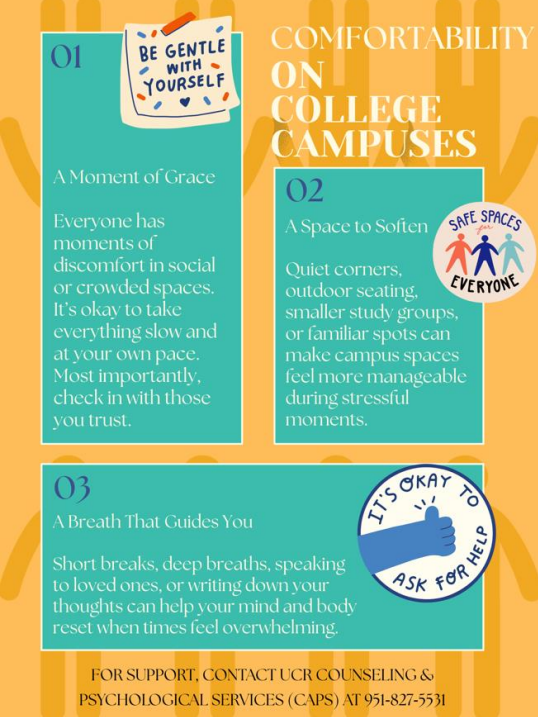
While this project reflects a relatively small, self-selected sample, the themes align with broader research on trauma-informed and community-oriented approaches to student mental health. The insights point to opportunities for UCR to continue strengthening existing wellness resources, expand access to calming campus environments, and promote low-barrier coping practices that students already find helpful. The infographic developed through this project provides a clear, accessible tool that walks students through step-by-step strategies for managing stress on campus while directing them to Counseling & Psychological Services (CAPS) for further support when needed.
Recommendations
Based on the themes identified in this project, several recommendations can support student mental health and reduce social anxiety on campus. At the individual level, students may benefit from increased access to wellness activities such as outdoor recreation, community-building events, yoga, meditation, and reading spaces designed for relaxation. These activities provide accessible coping strategies that promote emotional regulation, social connection, and stress reduction.
At the campus-environment level, the university can improve student comfort by integrating trauma-informed design principles into future planning. This includes creating quieter walkways, offering low-stimulus study areas, improving signage to reduce crowding, and designing indoor and outdoor spaces that minimize sensory overload. UCR’s extensive greenspaces and naturally shaded areas already offer a calming environment, though adding more accessible quiet seating or clearly designated low-stimulus zones could further support students who prefer calmer spaces.
UCR maintains a wide range of mental health and wellness services, including CAPS, the Holistic Health & Wellness Department, the Campus Advocacy, Resources & Education (CARE) office, the Student Recreation Center, and UCR Health. Sustained attention to these services, including efforts to make them more accessible and responsive through timely or same-day care, can further enhance the support students receive across campus. By continuing to resource these programs and ensuring that students can reach services quickly, including same-day or drop-in options, the university can further reinforce its overall support system. Collectively, these efforts aim to create a more supportive, accessible campus environment that enhances students’ emotional, physical, mental, and spiritual health.
Conclusion
The findings from this project highlight how deeply students’ sense of comfort is shaped by both their social environments and the physical spaces they move through each day. While social anxiety exists on a spectrum, one pattern was especially consistent across participants: community strengthens students’ sense of belonging and reduces anxiety, even in unfamiliar or unpredictable settings. Familiar peers, supportive friendships, and social circles created a buffer that helped students feel grounded, capable, and more at ease navigating campus life. This emphasis on connection emphasizes the importance of cultivating environments where students can build relationships that feel safe, reciprocal, and emotionally steady.
At the same time, the campus environment itself plays a meaningful role in shaping students' overall health. Quiet, low-stimulus spaces, clear pathways, and accessible outdoor areas offered students a sense of relief from crowded or overwhelming settings. These findings reinforce that a trauma-informed campus is not only about services, but about the design of everyday spaces that allow students to regulate, decompress, and move at a pace that feels manageable.
Ultimately, the primary concern of any university should be the mental health and overall, well-being of its students, as these factors directly influence their ability to learn, participate, and thrive academically. When students feel emotionally safe and supported through community, their capacity for engagement and academic success increases. By centering student well-being in both policy and practice, institutions can create learning environments that are not only more supportive, but more equitable and responsive to the diverse needs of their student populations.
Appendices
Appendix A. In-person Survey Instrument
Appendix B. Observation Checklist
Observation Checklist for Campus Social Interaction Patterns
Date & Time of Observation: February 26th at 12:30 PM to 3:30 PM
Locations Observed: walkways, library entrances, bus stops, greenspaces, department building and dining halls
Appendix C. Managing Anxiety on Campus Infographic